



Invest Now

Why invest in Puerto Rico?

Puerto Rico currently offers one of the most solid opportunities for investment in residential housing in the United States, supported by real, measurable, and diversified demand from three clearly identified sources, backed by official data and active government programs.

Oportunidad de inversión inmobiliaria en Puerto Rico

1 Regular customers

Regular customers are buyers who purchase homes through private financing or traditional mortgages. This segment is directly impacted by a structural housing deficit that Puerto Rico has been experiencing since the real estate and financial crisis of 2008.

Following the real estate and financial crisis of 2008, Puerto Rico's banking system suffered a severe contraction. The vast majority of banks operating on the island closed or left the market, including Scotiabank, RG Bank, Doral Bank, Citibank, Westernbank, Santander, Eurobank, and BBVA.

As a result, financing for developers has been drastically reduced. In practice, the financial institutions that remain active—mainly Banco Popular, Oriental Bank, and FirstBank—maintain highly conservative lending policies and, in general, are reluctant to grant large-scale financing for developments with a high number of units, requiring that projects be broken down into multiple small phases over extended periods of time.

This credit crunch caused a sustained decline in new housing construction, particularly affordable housing. However, during that same period, the population and the formation of new households continued to grow. The result is a structural gap between supply and demand: the need for housing continued to increase, but the available inventory did not grow at the same rate, creating a critical shortage of homes on the market.

At the beginning of the 21st century, around 12,000 new homes were being built in Puerto Rico. Then, during the economic crisis, by 2010, the number of new homes being built had fallen to around 4,000, and as recently as 2024, the number of newly built homes was less than 700.

Source: Puerto Rico Builders Association
https://www.constructorespr.com/news/la-falta-de-vivienda-en-puerto-rico-una-crisis-social

This context explains the persistent high demand from regular buyers in the face of an extremely limited supply of new housing.

Available financing programs:

  • Soon to Your Home: Direct assistance program for down payments and closing costs aimed at first-time homebuyers, providing non-repayable subsidies of up to $60,000.
  • Youth Housing: Mortgage product aimed at young people between the ages of 21 and 35 who have graduated in the last five years, offering preferential interest rates and financing of up to 98%–105%.
  • FHA loans: Mortgages insured by the federal government that allow for a reduced down payment (usually around 3.5%) and more flexible credit criteria.
  • VA Loans: Financing program for eligible veterans that allows 100% financing, with no down payment.
  • USDA Rural Development – Section 502 (eligible rural areas):
    • Section 502 Direct Loan Program: Program where financing is provided directly by the federal government to low- or very low-income families, with possible subsidies for monthly payments and extended terms that improve affordability.
    • Section 502 Guaranteed Loan Program: A program in which private banks grant loans with a federal guarantee from the USDA, reducing the lender's risk and allowing financing of up to 100% of the home's value.

We currently have a list of 264 qualified buyers. who can purchase our homes through private bank financing (without vouchers), further reinforcing the depth of demand beyond government programs.

2 Customers affected by Hurricane Maria

The second group consists of people whose primary residence was damaged or destroyed by Hurricane Maria in 2017.

Under the CDBG-DR R3 program, in cases where the affected home is located in a 100-year floodplain or high-risk area (according to the environmental review), and the estimated repair cost exceeds $60,000 or 50% of the current appraised value of the home (whichever is lower), the applicant qualifies for relocation. In these cases, the program may offer a voluntary acquisition of the affected property and issue a Relocation Voucher for the purchase of a replacement home outside of risk areas.

Beneficiaries who receive these relocation vouchers for the total value of a home constitute a significant segment of our customers, provided that the units meet the program's technical and price criteria, as is the case with our homes. There are currently 3,983 eligible relocation voucher applications.

Official information about the R3 program:

The Puerto Rico Department of Housing (PRDOH) R3 Program, funded by CDBG-DR funds, provides assistance for the repair or reconstruction of affected homes and, when applicable, relocation to safe housing. On its official website, the Government of Puerto Rico describes the scope of the program and publishes a total allocation of $2,922,780,619.

References:

Compliance of our units:

The 510 units we will build fully comply with all technical, eligibility, and price criteria established by the Puerto Rico Department of Housing (PRDOH) for CDBG-DR / R3 programs.

The homes are built in non-flood-prone areas and outside of risk zones. They are newly constructed units built from scratch, use permitted construction systems, exceed the minimum size requirements for the number of rooms, and have sale prices in line with the relocation vouchers issued by the program.

Consequently, our units qualify as eligible inventory for approved beneficiaries and CDBG voucher holders to purchase, complying with applicable regulatory, technical, and programmatic parameters. This comprehensive compliance supports the viability of the project, absorption by eligible beneficiaries, and effective execution of sales under the CDBG-DR program framework.

3 Customers affected by the 2020 Earthquakes

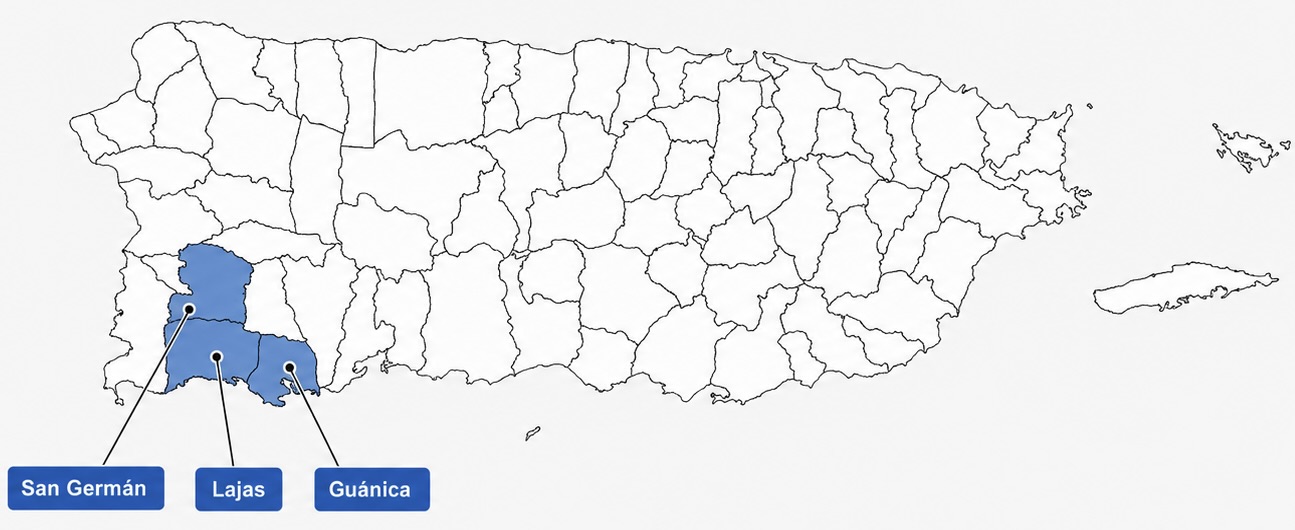
The third group consists of people who lost their homes as a result of the earthquakes that struck southern Puerto Rico between 2019 and 2020, severely affecting municipalities such as Guánica, Guayanilla, Lajas, Peñuelas, Ponce, and Yauco.

To address this situation, the ReSURge (CDBG-DR) program was created, administered by the Southern Consortium (ConSur) in coordination with the Puerto Rico Department of Housing. This program offers assistance for the repair, reconstruction, or relocation of affected homes and has an allocation of funds of $210,581,705.

Official information about the ReSURge program: https://resurge.pr.gov/en/index.html

Official statements:

Carlos R. Jirau Vélez, Executive Director of Consorcio del Sur (ConSur), met with us to learn about our available housing inventory, given that we are the largest developer in the area.

“Between 2023, 2024, and 2025, we received around 846 applications. As of today, we have around 450 eligible families already enrolled in the program.”

“There is not enough housing to meet people's needs, but over the next year and a half we should be impacting around 450 families who are either going to have a new home built for them or will be given the opportunity to be relocated to buy a home on the market in any of the municipalities.”

“The municipality of Guánica submitted the most applications, around 256.”

This is a situation where our participants have the voucher, they have the money to buy, but there is no house available.

— Carlos R. Jirau Vélez, Executive Director of the Southern Consortium (ConSur)
Interview for Es Noticia PR

Access to the full interview: Transcript and video of the interview

As part of this program, relocation vouchers have been issued for homes located outside risk areas. There are approximately 350 active cases. of beneficiaries with relocation vouchers, who currently face a significant shortage of available housing that meets the program's criteria.

Evolution of Housing Construction in Puerto Rico

12,000
New homes per year (2000)
4,000
New homes per year (2010)
-94%
Reduction since 2000
<700
New homes (2024)

Solid and Diversified Investment Opportunity

Together, these three segments—regular customers, Hurricane Maria beneficiaries, and 2020 earthquake beneficiaries—account for broad, diversified, and sustained demand, supported both by structural market conditions and active government programs with allocated funds, which reinforces the viability and absorption of our residential units.

The combination of these three segments of demand creates a unique investment scenario with assured demand, guaranteed financing, and a significant gap between supply and demand that guarantees the absorption of new developments.